
 EN
EN TH
TH CN
CN
Ror.Ngor.4 refers to a ‘Factory Operation License,’ a document issued by the department or agency responsible for industrial operations in Thailand. This document allows individuals or companies to start a factory operation in a specified location and scope. Entrepreneurs who want to construct a factory building and have it pass without problems during the application for construction and other permits, must be aware of relevant building laws.
It requires compliance with rules and conditions stated in the permit. The license typically specifies details about the factory, such as the type of industry, factory size, operation rights, and conditions. This includes environmental controls and safety regulations. It’s a crucial document for compliant and legal factory operations.
Table of Contents
2. Application for permission to establish a factory
3. How many factory types require a setup permit?
4. Factory License Application Procedure (Ror.Ngor.4)
- Document Preparation
- Application for a permit
- Verification and Consideration
- Permitting and Licensing (Form Ror. Ngor. 4)
5. Consequences of establishing a factory without permission
What is a factory

A factory is a building, place, or vehicle that uses machinery with a total power of 50 horsepower or more, or employs 50 or more workers, for making, producing, assembling, packing, repairing, maintaining, testing, improving, modifying, transporting, storing, or destroying anything. Factories are usually large and are designed to be able to produce goods efficiently and deliver them in the required quantities. Factories are often categorized according to the nature of their production. They may be factories that produce a variety of goods such as processed food, beverages, pharmaceuticals, cleaning products, electronics, automobiles, and others.
Factories have different operating characteristics and production systems depending on the type of product. Most factories have systematic production processes to enable efficient control of production, including quality inspection and testing to ensure high-quality products that meet specified standards. Factories use modern tools and technologies to aid in the production process, such as automated machinery, control systems, and computers. The use of the Internet of Things (IoT) and the adoption of other technologies are also implemented.
Application for permission to establish a factory

There are several important reasons for requesting permission to establish a factory, to ensure that the factory’s operations are carried out correctly and in an orderly manner. These are the main reasons why it is necessary to request permission to establish a factory:
1. Safety and Environment
The intention of requiring factory establishment permits is to prioritize safety and environmental protection. This includes ensuring that the factory will not cause environmental pollution or create risks for nearby residents. The permitting process allows the government and relevant agencies to thoroughly inspect and evaluate the project before the factory can actually begin operations.
2. Compliance with the law
Applying for a factory license is an adherence to laws and related regulations, such as obtaining permission to manufacture or process materials with specific requirements. This is to ensure that the factory will comply with the established laws and regulations.
3. Quality Control
Factory licensing helps ensure strict quality control of manufactured products or goods. It often involves inspections and certifications to ensure that the production process meets established standards. This builds confidence among customers and in the market that the factory’s products are of high quality.
4. Planning and Management
Obtaining a factory establishment permit allows entrepreneurs to have an appropriate organizational structure and operational plan. It involves managing human and financial resources appropriately to enable the factory to operate efficiently.
In conclusion, obtaining a factory establishment permit is a crucial step to ensure that the business can operate legally and correctly, as well as maintaining safety and controlling the quality of the products manufactured.
How many factory types require a setup permit?
- Category 1 factories are types, kinds, and sizes of factories that can commence operations immediately.
- Category 2 factories are types, kinds, and sizes of factories that, before commencing operations, must notify the permitting authority.
- Category 3 factories are types, kinds, and sizes of factories that require a permit before they can be established and begin operations.
Factory Type 1

Type 1 factories are those that may have specific characteristics in their industrial production or whose main activity is any industry, with a total machinery power not exceeding 20 horsepower (HP) or equivalent and employing no more than 20 employees or workers. These are removed from the list and do not qualify as factories under the law. Examples of Type 1 factories may include:
- Factories for jewelry production: Factories that produce jewelry or accessories used for dressing or personal presentation, such as gold jewelry factories, diamond jewelry factories, or silver jewelry factories.
- Shoe repair and leather goods factories: Factories that produce and engage in the repair of shoes and the production of various leather goods used for wearing and use, such as leather bag factories, shoe factories, and artificial leather factories.
- Household product manufacturing factories: Factories that produce household appliances or everyday items, such as home appliance factories, kitchenware factories, or home-use cosmetic factories.
Type 1 factories may have many additional types, and each type may have different characteristics and production processes, depending on the nature of the industry and the products manufactured in that factory.
Factory Type 2

It may be a factory with characteristics or activities that vary according to different criteria. Mostly, these are factories that have a total machinery of no more than 75 horsepower (HP) and no more than 75 employees or workers. If it is this type of factory, it can start operations immediately. There is no need to apply for a factory operating permit, but annual fees must be paid, and have a postive effect to the environment. Category 2 factories include the following types of factories:
- Factories for the production of basic goods: Factories that produce basic goods or everyday products, such as clothing factories, shoe factories, or cosmetic factories.
- Factories for the production of industrial goods: Factories that produce industrial goods or raw materials used in industry, such as steel and steel product factories, plastic factories, or electronics factories.
- Factories for food production: Factories that produce food or beverages, such as dried food factories, processed meat factories, or fruit juice factories.
Category 2 factories may have many additional subcategories, and each type may have different characteristics and production processes, depending on the nature of the industry and the products being manufactured in that factory.
Factory Type 3
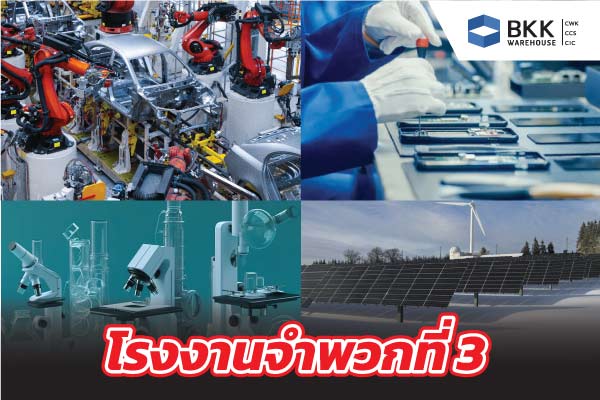
Without specifying the exact type of factory, Category 3 factories can be characterized by different criteria. Factories with combined machinery of 75 horsepower (HP) or more, or the equivalent, and with more than 75 employees or workers, are in this category. If a factory meets these criteria, it must request permission to establish the factory from the Department of Industrial Works, Ministry of Industry. After submitting the request, they will receive a Ror.Ngor.3 document, and they must also apply for a factory operation permit, which is the Ror.Ngor.4. Examples of Category 3 factories may include:
- Automotive Factories: Factories in this group produce automobiles and related components. Automobile manufacturing is a complex process that utilizes advanced technology. These factories have machinery and tools used in assembling vehicles, both for production and quality testing.
- Information Technology Product Manufacturing Factories: Factories that produce tools or equipment used in communication and information technology, such as computer manufacturing plants, mobile phone manufacturing plants, or game console manufacturing plants.
- Medical Device Manufacturing Factories: Factories that produce medical devices or instruments, such as factories producing surgical instruments, factories producing health monitoring equipment, or factories producing medication dispensing devices.
- Energy Product Manufacturing Factories: Factories that produce energy or energy-related equipment, such as solar cell manufacturing plants, generator manufacturing plants, or energy conservation equipment manufacturing plants.
Category 3 factories may include many other types and may cause pollution problems, nuisance, or hazards that require close supervision. Manufacturers must request permission before establishing the factory, and once the permit is granted, they can set up the factory. Before commencing operations, they must notify the authorities of their intent to operate.
Note
- Factories of categories 1, 2, and 3 are prohibited from constructing factories within residential housing estates, residential condominiums, and residential townhouses.
- Factories of categories 1 and 2 are prohibited from constructing factories within a 50-meter radius of the boundaries of schools, educational institutions, temples, religious sites, hospitals, historical sites, government agency workplaces, and areas of natural resource and environmental conservation.
- As defined by law, [factories] must be located in a suitable location and environment, with sufficient area to conduct operations according to the type or kind of factory, without causing danger, nuisance, or damage to persons or the property of others.
Factory License Application Procedure (Ror.Ngor.4)

A factory operating license is a document issued by the agency or department responsible for industrial operations in the country. The issuance of licenses depends on the laws and local regulations of each country or region. Therefore, the details recommended in the sequence of steps and required documents may vary. Generally, it will consist of the following steps:
1. Document Preparation
Preparing documents to apply for a factory operating license (Form Ror. Ngor. 4) is a process that must follow the steps and criteria set by the agency or department responsible for industrial operations in Thailand. Therefore, the steps and documents required for preparing Form Ror. Ngor. 4 may vary according to the nature and size of the factory applying for the license. However, the following is a list of documents that may be relevant to the preparation of Form Ror. Ngor. 4, which may be changed or supplemented according to the conditions and regulations of each agency.
- Application form (the form prescribed by the agency)
- Copies of the house registration of the applicant and spouse (in the case of a natural person)
- Copies of the juristic person certificate or company registration certificate (in the case of a juristic person)
- Documents detailing the factory, such as location maps, size and construction details, information on machinery and equipment used, production plans, and information on environment and safety.
- Other documents as required by the responsible agency.
To successfully prepare the documents, you should contact the relevant agencies to request information and further guidance, such as the Department of Industrial Works or the Office of Industrial Development, and follow the prescribed steps and conditions correctly in order to obtain a correct and complete Form Ror. Ngor 4.
2. Application for a permit
Bring the prepared documents to submit an application for a permit to the responsible agency or department. The application may need to specify information about the factory’s operations, such as location, size, and nature of the factory, the production processes used, and environmental control plans. Submitting an application for a factory operating permit is a process that factory operators must undertake to obtain permission to establish and operate a factory from the agency or department responsible for industrial operations in Thailand.
3. Verification and Consideration
Inspection and consideration are processes that departments or agencies responsible for industrial operations use to verify compliance and adherence to relevant laws and regulations regarding the establishment and operation of factories by applicants.
The inspection and consideration process functions as follows:
- Document Inspection: Officials will review the completeness and accuracy of the documents that the applicant must submit for the operation of the factory. This includes application documents, factory location maps, information about the factory, etc.
- Site Inspection: Officials will visit the site where the applicant intends to establish the factory to assess the suitability and safety of the location.
- Consideration: Officials will review all information and documents submitted by the applicant to verify compliance with laws and regulations, including considerations regarding the project’s suitability and environmental impact.
- Issuance of Factory Permit (Ror. Ngor. 4): If the applicant passes the inspection and consideration process successfully, the responsible department or agency will issue a permit to the applicant to commence factory operations.
The main objective of the inspection and consideration process is to verify compliance with laws and regulations to maintain safety and protect the environment, as well as to build public confidence that the factory will operate correctly and responsibly towards society and the environment.
4. Permitting and Licensing (Form Ror. Ngor. 4)
If the inspection and review are successfully completed, the responsible agency or department will issue a factory operation permit to you. This permit will specify detailed information about the factory operation, such as the type of industry, the size of the factory, the rights, and the conditions of operation.
Consequences of establishing a factory without permission

If a factory is established without obtaining the legally required permits and in violation of established regulations, legal problems will arise, and this could have consequences for both the business and society, as follows:
1. Violation of the law
Establishing a factory without obtaining the necessary permits may be a violation of laws related to industrial operations, which could lead to maximum penalties. This includes violations of environmental laws, safety and hygiene laws, or laws concerning factories and factory establishment.
- Criminal Law Violations: Setting up a factory without authorization or compliance with the law can constitute a criminal offense. This could lead to maximum penalties, such as violations of environmental laws or violations of safety and hygiene laws.
- Damage to Other Businesses: Establishing a factory without complying with the law can cause harm to other businesses that are operating legally. This can create unfair competition in the market or lead to business encroachment.
- Environmental and Social Impacts: Setting up a factory without legal compliance can result in environmental problems, such as the release of pollutants into the air, water, or soil, which can be harmful to living organisms. It can also cause dissatisfaction in nearby communities. Disputes and other social problems may arise.
Establishing a factory without permits and legal compliance is not equivalent to establishing a proper and sustainable factory. Adherence to relevant laws and regulations is crucial to building trust with businesses, society, and the environment.
2. Damage to nature and the environment
Establishing a factory can have direct or indirect impacts on nature and the environment. Examples of potential damage include:
- Pollution: Some types of factories may have production processes or activities that generate toxic substances or harmful gases. Releasing pollutants into the air or wastewater can harm organisms living in the area and can damage the ecosystem and ecology in the long term.
- Natural Resource Consumption: Large factories may require a significant amount of water. Competition for water resources can lead to water shortages or the degradation of local water resources. Furthermore, energy consumption from non-clean energy sources can impact the environment and deplete natural resources.
- Contamination: Factories that use chemicals or other hazardous materials can cause air, water, or soil contamination. This contamination can affect organisms and ecosystems both upstream and downstream.
- Landscape Alteration: Establishing a large factory can cause landscape changes, such as land modification, the destruction of forests or areas of natural value. This results in the loss of natural resources and landscape conditions that are detrimental to the environment and landscape balance.
Environmental and natural degradation is a significant issue with long-lasting consequences for communities and society as a whole. Therefore, factory operations should comply with environmental laws and conduct environmental impact assessments to minimize damage and create sustainable outcomes for the environment and society, both now and in the future.
3. Impact on society and the community
Establishing a factory can create conflict or dissatisfaction in the community. There may be objections from local residents due to noise, pollution, depletion of local resources, or changes to the landscape. High-quality environmental management of the factory and creating beneficial outcomes for the community can significantly help reduce social impacts.
Recommended articles
What is inventory? Understanding inventory in business operations.
Read the contentMar
What is a distribution center? A key component of modern logistics.
Read the contentMar
What’s a warehouse? Why it matters. Types & Functions explained.
Read the contentFeb
What is purple zone land? Ideal uses and information. Check here!
Read the contentFeb
Land survey fees. Costs, steps, docs. Must-know before land deals.
Read the contentJan
GMP. What is it? Importance, users, and a simple business guide.
Read the contentNov