
 EN
EN TH
TH CN
CN
Shipping containers are large metal containers used to transport goods by sea, rail, and truck. They have standard sizes to allow for easy and fast transportation. They help reduce transportation costs and protect goods from damage during transit. There are various types of shipping containers, depending on the type of goods being transported. They make the transportation of large quantities of goods more efficient and economical.
Dry container

This container type is the main standard container type in Thailand. It is the most commonly used type of container. It is used to transport goods that do not require temperature control, such as furniture, appliances, and clothing.
Dry containers have the following standard sizes:
20-foot Container Dimensions:
- Width: 8 feet (2.44 meters)
- Height: 8.5 feet (2.59 meters)
- Length: 20 feet (6.06 meters)
- Approximate Storage Capacity: 30 cubic meters
- Maximum Weight Capacity: 28 tons (260,000 kilograms) There’s a typo here, it repeats the weight and the number of kilograms is incorrect.
- Max Volume: 33 CBM
40-foot Container Dimensions:
- Width: 8 feet (2.44 meters)
- Height: 8.5 feet (2.59 meters)
- Length: 40 feet (12.19 meters)
- Approximate Storage Capacity: 60 cubic meters
- Maximum Weight Capacity: 26 tons (260,000 kilograms) There is a typo; 26 tons is 26,000 kilograms.
- Max Volume: 67.50 CBM
40-foot High Cube (HQ) Container Dimensions:
- Width: 8 feet (2.44 meters)
- Height: 9.5 feet (2.90 meters)
- Length: 40.3 feet (12.30 meters)
- Approximate Storage Capacity: 68 cubic meters
- Maximum Weight Capacity: 26 tons (260,000 kilograms) There is a typo; 26 tons is 26,000 kilograms.
- Max Volume: 76.20 CBM
Dry containers have doors at one end that can be opened for easy loading and unloading of cargo. The doors can be double doors or a single door.
Dry containers are typically made of steel or aluminum and may be coated or painted to protect against corrosion and weather damage. Some types of dry containers may have special features, such as ventilation or moisture control, to suit the transportation of various types of goods.
Dry container usage
Dry containers are used to transport a wide variety of goods, including:
- Commodities such as wheat, corn, and soybeans.
- Industrial goods such as machinery, auto parts, and construction materials.
- Consumer goods such as furniture, appliances, and clothing.
- Hazardous goods such as chemicals and flammable materials (specially certified dry containers are required).
Dry containers are a safe and efficient way to transport goods. They help protect goods from damage and theft. Dry containers can also be transported by various modes, such as sea, road, and rail, making them a flexible option for transporting goods around the world.
Advantages of this type of container
- Resistant to weather conditions to keep goods dry and undamaged during transport.
- Provides secure storage, preventing breaches or theft of goods.
- Reusable, making them environmentally friendly and cost-effective in the long run.
- Available in a variety of sizes, allowing businesses to choose the most suitable container for their goods.
- Customizable to meet specific safety or loading requirements.
- Cost-effective through efficient space utilization, reducing shipping costs and maximizing profits.
These advantages make dry containers a popular choice for businesses that need to transport goods globally without refrigeration or special handling.
Reefer container

A temperature-controlled container is a special type of container designed to control and maintain a constant internal temperature. It is typically used to transport perishable goods such as food, fruits, vegetables, and pharmaceuticals.
Qualifications
- Has a built-in cooling or heating system.
- Can set the temperature precisely.
- Has a temperature monitoring and recording system.
- Has thermal insulation to maintain the internal temperature.
- Has a ventilation system to ensure proper air circulation.
How many types of reefer containers are there
- Refrigerated temperature-controlled containers: Maintain temperatures below freezing.
- Heated temperature-controlled containers: Maintain temperatures above freezing.
- Humidity-controlled temperature-controlled containers: Maintain optimal temperature and humidity levels.
Uses of temperature-controlled shipping containers
Temperature-controlled shipping containers are used to transport goods that require precise temperature control, such as:
- Food and beverages
- Fruits and vegetables
- Pharmaceuticals
- Biological materials
- Temperature-sensitive electronic products
Advantages of this type of container
- Maintain product quality and freshness
- Reduce waste and spoilage
- Extend shelf life
- Comply with hygiene and safety regulations
- Reduce the risk of bacterial and fungal growth
Open top container

Open-top containers are a type of shipping container that lacks a solid roof. Instead, they have an open top that can be covered with a tarpaulin or a removable steel roof, which acts as a lid for more secure transport and protects goods from rain and dust. They are used for transporting cargo that is taller than standard containers (e.g., for cargo that is 2.7 meters high) or cannot be loaded through the doors of a standard-sized container.
Open-top containers allow for easy loading and unloading of goods from above using a crane or forklift. This makes them suitable for handling loose materials such as scrap metal, stone, or minerals. The dimensions of open-top containers are similar to standard dry storage containers, commonly coming in lengths of 20 feet or 40 feet.
Uses for open-top shipping containers
Open-top containers for transporting raw materials or goods that exceed the height of a standard container.
- Raw materials for construction.
- Irregularly shaped goods.
- Goods that are taller than a standard container.
Advantages of this type of container
- Facilitates easier loading and transportation of oversized or uniquely shaped cargo.
- Convenience in loading and unloading: The open top makes loading and unloading easier.
- Versatility in using containers: For transporting a wide variety of raw materials or goods that are oversized or have special characteristics.
- Helps increase the safety of cargo transportation: Because loading and unloading can be controlled with confidence and security.
- Therefore, it is a good choice for loading and transporting goods that are oversized or have unique characteristics.
Flat rack container

This type of container has no side walls, back, or ceiling. It has a flat-rack structure, suitable for cargo that does not fit in standard containers. This type of container has a relatively high cost because it can easily and conveniently carry oversized or specially shaped cargo.
Qualifications
- Has a strong structure suitable for transporting heavy goods.
- The top and bottom are steel plates or durable materials used as the base for the goods.
- It is large and can be used to transport goods with a width or height that exceeds that of a standard container.
Uses for flat rack containers
Suitable for transporting oversized cargo, such as:
- Industrial machinery
- Large industrial components
- Construction materials that cannot fit inside standard containers.
Advantages of this type of container
- Ability to load and unload cargo easily. Flat rack containers often have posts that can be removed.
- Easy to load and unload oversized cargo, without any height restrictions.
- Lightweight when empty, making sea transport convenient and reducing shipping costs.
- Versatility in use, depending on the situation, such as transporting raw materials, use in special projects, or use in construction projects.
- Cargo can be securely tied or fastened onto the flat rack container, preventing damage during transport.
- Can be reused multiple times without losing functional value.
ISO Tank Container

This type of container is used for liquid goods. The capacity of the tank ranges from 11,000 liters to 26,000 liters, depending on the type of tank. This type of container is also used to transport hazardous liquids. Generally, loading liquids using an ISO Tank allows for a larger volume than loading drums into a container. In addition, using an ISO TANK is also easier for transportation and loading.
Qualifications
- The durable structure is built from robust materials, such as steel or stainless steel, to withstand pressure and impact during transportation.
- The inner walls of the container are specially designed to be resistant to chemicals to prevent corrosion or leaching.
- The exterior of liquid shipping containers is often designed to prevent leakage of the contents.
- There is a valve control system that helps control the flow of chemicals within the container to prevent leaks or improper pressure.
- Some liquid shipping containers may have additional features such as chemical level monitoring systems, temperature control systems, or leak detection systems.
- They are designed to withstand various weather and environmental conditions, such as heat, cold, and humidity.
Uses for liquid bulk shipping containers
Suitable for transporting hazardous materials:
- Oil
- Chemicals
- Various chemical substances
Advantages of this type of container
- Possesses a robust structure to prevent leakage or damage to goods during transportation.
- Offers ease of use, allowing for direct connection and lifting onto trucks or trains.
- Provides simple management due to compatibility with standard logistics and transportation systems.
- Saves both time and money in transferring liquid goods, eliminating the need for packing and unpacking.
- Reusable multiple times without loss of functional value.
- Protects against degradation from environmental factors such as heat, cold, and humidity.
- Suitable for transporting a wide variety of goods, such as oils, chemicals, and various chemical substances.
Ventilated Container
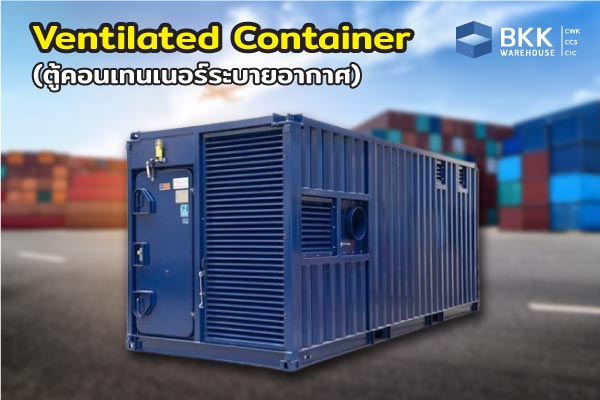
Ventilated containers, or ventilated shipping containers, are designed to allow internal air circulation to help vent air and moisture from the container. They have different characteristics and uses than standard shipping containers.
Qualifications
- Has a ventilation system that allows air to circulate within the container. Typically, vents are located at the top or bottom of the container.
- Has the ability to remove moisture from the container, reducing the humidity inside. This is an important factor in reducing the risk of damage to goods.
- Has a durable steel or stainless steel structure to support ventilation and humidity control effectively.
- Has a robust structure that can withstand the stresses of movement and cargo loading.
- Prevents damage to goods. Ventilation and humidity control reduce moisture inside the container.
- Suitable for use in hot or humid climates.
Uses for ventilated shipping containers
Suitable for transporting goods that must be protected from moisture:
- Coffee beans
- Cocoa beans
- Agricultural products
Advantages of this type of container
- Helps maintain the freshness of the goods inside, reducing the risk of damage from spoilage or degradation.
- Helps ventilate unwanted odors out of the container, which helps maintain the cleanliness and freshness of the goods.
- Helps reduce heat and humidity inside the container.
- Versatile in use and cheaper than temperature-controlled containers.
- Reduces the risk to the convenience of accessing quality goods, and upon arrival at the recipient, they are ready for immediate distribution.
In conclusion, the choice of container type depends on the nature of the goods being transported and the specific conditions of each situation. This ensures that the transportation of goods is safe and efficient for the business you are operating.
Recommended articles
What is inventory? Understanding inventory in business operations.
Read the contentMar
What is a distribution center? A key component of modern logistics.
Read the contentMar
What’s a warehouse? Why it matters. Types & Functions explained.
Read the contentFeb
What is purple zone land? Ideal uses and information. Check here!
Read the contentFeb
Land survey fees. Costs, steps, docs. Must-know before land deals.
Read the contentJan
GMP. What is it? Importance, users, and a simple business guide.
Read the contentNov