
 EN
EN TH
TH CN
CN
The 7S model is one of the theories for successful business operation. Strategic planning is a crucial process that helps businesses define goals, determine the best course of action to achieve results, and allocate resources efficiently. It is one of the theories that gather all together the guidelines for building a bussiness, the seven factors. It is an important concept, one of the key that all entrepreneurs should be aware of, as it’s a globally used framework. This framework helps organizations operate systematically and enables present-day businesses to grow sustainably into the future.
Currently, it is not easy for entrepreneurs because our world and technology are rapidly changing. Businesses such as logistics, transportation, warehousing, manufacturing plants, or even small businesses like supermarkets, are constantly changing and growing. Therefore, the 7S theory plays a vital role as a helpful tool and guide for all business owners. It focuses on learning, and organizational development to keep pace with the ever-changing market, economy, and the world.
What is the McKinsey 7-S Framework?
The McKinsey 7-S Framework is a management model developed by the consulting firm McKinsey & Company. Founded in 1926 by James O. McKinsey, the firm initially focused on accounting and engineering consulting. Later, McKinsey expanded its services and client base, offering management consulting services to various industries, including finance, manufacturing, healthcare, and technology.
It is a framework that helps organizations assess and align seven key elements to achieve business effectiveness and success. These elements are: Strategy, Structure, Systems, Skills, Staff, Style, and Shared Values. By analyzing and harmonizing these interconnected factors, businesses can improve their overall performance and achieve their goals.
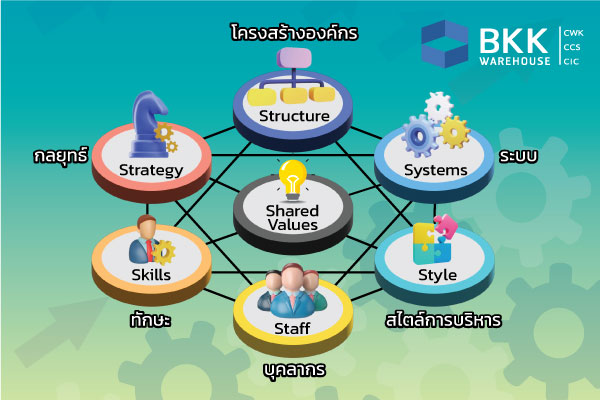
An organization can advance by using the principles and guidelines from the 7-S McKinsey Framework theory, with the following distinct interpretations:
- Strategy: (Strategic Process)
- Structure: (Organizational Structure)
- Style: (Management Style)
- System: (Work Systems / Operating Systems)
- Staff: (Personnel/Staff)
- Skill: (Employee Skills)
- Shared Value: (Shared Values)
The 7-S Model enables sustainable business growth

Strategy
Strategy refers to a well-thought-out plan or approach designed to achieve a specific goal or objective. It involves analyzing the current situation, setting clear goals, and determining the best course of action to achieve those goals. A strategy typically takes into account various factors such as market conditions, competition, resources, and potential risks. It serves as a roadmap for decision-making and guides the allocation of resources and efforts to maximize the chances of success.
Structure
Structure refers to the organization of various components within a system or entity (or entity type). It establishes a framework that defines how the positions and roles of employees in an organization, including management, relate and work together to achieve specific objectives or functions within various contexts. In the McKinsey 7-S framework, structure, leading to business success, can refer to the management of the chain of command, the organization, or new conceptual ideas. It effectively creates order, interconnectedness with strategy, and stability within the system.

Style
Style refers to the leadership and internal culture within a business. It influences employee behavior and attitudes, as well as the overall atmosphere of the organization. It encompasses the management styles, approaches, and characteristics that leaders use to lead and interact with employees in their company. This includes how they make decisions, communicate, delegate tasks, and handle conflicts.
Managers may have different styles, such as autocratic, democratic, laissez-faire, transformational, and many others. Each management style has its own advantages and disadvantages, and the most effective style may vary depending on the situation and the individuals involved in the organization.

System
A system refers to interconnected components or processes that work together to achieve specific goals or outcomes. It involves the coordination, organization, and development of various elements to ensure smooth functioning and efficient operations. It is also know as information system. It’s a framework of interconnected components that collect, process, store, and distribute information within an organization. It involves hardware, software, personnel, procedures, and data.
All of these work together to support the organization’s goals and facilitate the analysis process of cause and effect. The system helps in data management, automation, improves efficiency, and enhances communication within the organization. This may include various subsystems such as human resources, finance, inventory management, customer relationship management, and others. The ultimate goal is to improve operations and enable effective resource management.

Staff
Employees, also known as personnel, are individuals hired in accordance with the 7S McKinsey Framework. For example, hired employees must possess skills that enable them to perform their duties according to the organization’s objectives. Or, employees must have a good attitude and be able to work with others, which aligns with the factors of organizational structure and shared values. to carry out various tasks and responsibilities. They are a vital part of the organization and play a crucial role in its overall operation.
Employees can be divided into various departments or teams based on their areas of expertise and job roles. They contribute to the overall operations and are another key component that helps the business grow, achieve success, and comply with the company’s various regulations and requirements. This ensures that both existing and new employees consistently perform their assigned duties effectively.

Skill
Skills refer to the specific abilities and knowledge that employees possess and utilize in performing their jobs within an organization. These skills can vary depending on the nature of the organization and the structure of various work processes within the company. Outstanding employee skills that organizations often prioritize include expertise in areas such as design, production, sales, and logistics.
These are just a few examples of employee skills that organizations value. The specific skills required will depend on the industry, goals, and job roles within each organization. It is alinged with McKinsey 7s model, skill is a factor that company must hire right employees to meet the objective of the business.

Shared Value
Shared Value refers to values that are used collectively, a concept related to creating economic value while simultaneously addressing societal needs and challenges. It goes beyond traditional corporate social responsibility by integrating all 7-S McKinsey factors to incorporate social and environmental considerations into a company’s core strategy and operations.
The goal of shared value is to create benefits for both the business and society, leading to long-term sustainability and shared prosperity. By aligning business interests with progress, staying up to date on technology and global economic growth, companies can contribute to solving social problems and create a positive impact for the organization in the same direction.
In summary, the 7-S Model (or 7-S McKinsey) is a strategic theoretical framework that helps businesses achieve their desired goals and objectives with maximum efficiency. It provides a structured approach to strategy implementation and helps businesses clearly identify areas for improvement. It focuses on elevating organizations that use this theory, helping them to develop and grow smoothly into the future. So, for those who are running a business, don’t forget to apply the 7-S theory to benefit your organization.
Recommended articles
What is inventory? Understanding inventory in business operations.
Read the contentMar
What is a distribution center? A key component of modern logistics.
Read the contentMar
What’s a warehouse? Why it matters. Types & Functions explained.
Read the contentFeb
What is purple zone land? Ideal uses and information. Check here!
Read the contentFeb
Land survey fees. Costs, steps, docs. Must-know before land deals.
Read the contentJan
GMP. What is it? Importance, users, and a simple business guide.
Read the contentNov